
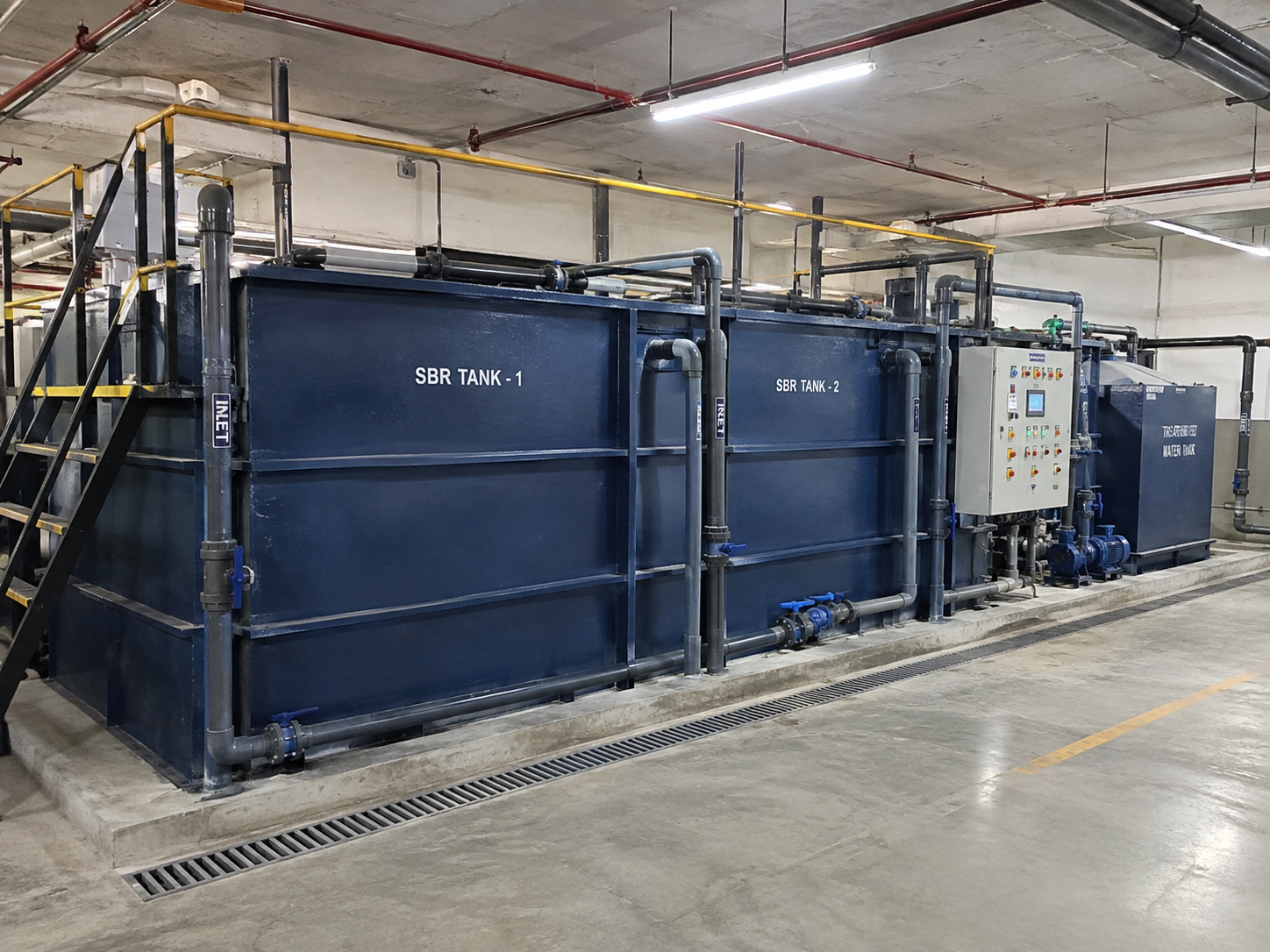
If you are building or managing a residential complex, mall, hotel, or office park in India, an on-site sewage treatment plant (STP) is no longer optional — it is mandated by pollution control boards, the National Green Tribunal, and most municipal building bylaws. The question is not whether to install an STP, but which technology to choose.
For commercial & residential buildings, the SBR (Sequential Batch Reactor) STP plant has emerged as the clear favourite. It treats sewage in a single compact basin through a timed batch cycle, delivers treated water clean enough for flushing and gardening, and runs almost entirely on automation. This guide explains how the SBR process works, how to size it, what compliance requires, and what an SBR STP costs in India in 2026.
What Is an SBR STP Plant?
SBR stands for Sequential Batch Reactor. It is a fill-and-draw version of the activated sludge process: instead of sewage flowing continuously through separate aeration, clarification and sludge-return tanks, everything happens sequentially in a single basin — fill, aerate, settle, decant, repeat.
Each batch takes 4–8 hours, so a typical plant runs 3–6 cycles per basin per day. Because settling happens in the same tank where biological treatment occurs, an SBR plant eliminates the secondary clarifier entirely — which is why it fits into the basements, stilt areas and terrace utility zones of buildings where every square metre counts.
The entire cycle is managed by a PLC (Programmable Logic Controller) that opens and closes valves, starts and stops blowers, and lowers the decanter on schedule. Once commissioned, the plant largely runs itself.
How the SBR Process Works: The 5-Phase Cycle
Every SBR sewage treatment plant for a residential or commercial building repeats these five phases automatically:
Phase 1
Fill — Raw Sewage Enters the SBR Basin
Screened and de-gritted sewage from the building's collection tank flows into the SBR basin. The batch fills over 1–2 hours while the aeration grid is idle or on slow mixing, protecting the biomass from shock loading — important for buildings where morning and evening flows peak sharply.
Phase 2
React (Aerate) — Biological Treatment
Fine-bubble diffusers supplied by blowers aerate the mixed liquor for 2–4 hours. Aerobic bacteria consume the organic pollutants, cutting BOD and COD simultaneously. Nitrification and, through intermittent anoxic mixing, denitrification happen in the same basin — no separate anoxic tank is needed.
Phase 3
Settle — Clarification Without a Clarifier
Aeration stops and the biomass settles under ideal quiescent conditions for 45–60 minutes, forming a dense sludge blanket. Because settling happens in the same basin, the footprint of a second clarifier is eliminated — a key reason SBR plants fit into basements and compact utility areas of residential towers.
Phase 4
Decant — Clear Treated Water Withdrawn
A floating or fixed-weir decanter withdraws only the clarified supernatant, leaving the settled biomass untouched. The decanted water is polished through pressure sand and activated carbon filtration, then disinfected — ready for toilet flushing, landscaping and cooling-tower make-up.
Phase 5
Idle & Sludge Withdrawal — Reset for the Next Batch
Excess sludge is pumped to a sludge holding tank and dewatered in a filter press or sludge drying bed. After a short idle period, the PLC automatically starts the next fill-react-settle-decant cycle — a complete cycle runs 4–8 hours, giving 3–6 treatment batches per basin per day.
Why SBR Is the Best STP Choice for Commercial & Residential Buildings
Building projects have a unique constraint set: limited space, fluctuating occupancy, strict reuse norms, and no room for process failures next to homes and offices. SBR answers each one:
- Compact footprint: No secondary clarifier and no separate anoxic tank — an SBR plant needs up to 40% less area than a conventional activated-sludge plant, fitting into basements, terraces and stilt areas.
- Superior treated water quality: Quiescent settling produces consistently low BOD and TSS, comfortably meeting reuse norms for flushing, gardening and cooling make-up.
- Fully automated operation: A PLC sequences fill, aerate, settle and decant automatically — no skilled operator needed around the clock, keeping O&M costs low for RWAs and facility teams.
- Handles fluctuating loads: Batch operation absorbs the sharp morning and evening peaks typical of residential and commercial occupancy without process upset.
- Odour control built in: Enclosed basins with fine-bubble diffusers and optional odour-control units keep residential surroundings free of nuisance smells.
- Lower capital and lifecycle cost: Fewer tanks, no clarifier mechanism and simpler civil works reduce both capex and long-term maintenance compared with conventional systems.
SBR vs MBBR vs MBR: Which Technology Fits Your Building?
| Parameter | SBR | MBBR | MBR |
|---|---|---|---|
| Footprint | Small — no secondary clarifier | Medium — clarifier needed | Smallest |
| Treated water BOD | Below 10 mg/L | 10–30 mg/L | Below 5 mg/L |
| Membranes / consumables | None | None | Membrane cassettes — periodic replacement |
| Automation & operator | PLC batch control, no dedicated operator | Low–medium | High — skilled O&M essential |
| Capital cost | Moderate, lowest lifecycle cost | Lowest upfront | Highest |
| Best for | Residential towers, malls, hotels, offices | Simple discharge-only plants | Space-critical premium reuse projects |
MBR delivers marginally better water but at a significantly higher capital and maintenance cost, while MBBR trades treatment quality for the lowest upfront price. For buildings that must reuse water and keep O&M simple, SBR is the balanced choice — which is why it dominates new residential and commercial STP specifications across India.
Sizing Your STP: KLD Guide for Buildings
STP capacity is expressed in KLD (kilolitres per day). The standard sizing basis is 135–150 litres per person per day of water consumption, with roughly 90% returning as sewage. Use this table as a first estimate, then confirm with your municipal bylaws:
| Building Type | Typical STP Capacity | Recommended Configuration |
|---|---|---|
| Up to 20 flats / small office | 10–20 KLD | Compact packaged SBR — terrace or stilt installation |
| 50–100 flats | 30–50 KLD | Single-basin SBR with fully automated PLC control |
| 100–200 flats | 50–120 KLD | Two-basin SBR so one basin can be serviced without stopping treatment |
| Malls, hotels & hospitals | 100–500 KLD | Multi-basin SBR with online effluent monitoring (OCEMS) |
| IT parks & campuses | 500+ KLD | Modular SBR trains with SCADA and closed-loop water reuse |
Compliance: CPCB, NGT & Local Building Bylaws
An STP for a commercial or residential building must satisfy four layers of regulation before it can legally operate:
CPCB & State Pollution Control Board norms
Treated sewage must meet the discharge or reuse standards prescribed by the CPCB and your state board — typically BOD ≤ 10–30 mg/L, TSS ≤ 50–100 mg/L, pH 6.5–9.0, with faecal coliform limits before reuse for flushing and irrigation.
NGT and judicial directives
National Green Tribunal orders and court directives require new large residential and commercial projects to install on-site sewage treatment before occupation certificates are issued.
Municipal building bylaws
Most major municipal corporations mandate on-site STPs for buildings above a threshold — commonly 20 or more flats, or a specified built-up area or plot size. Check your city's development control rules before finalising capacity.
Monitoring & record keeping
Larger plants require flow meters, online pH and quality monitoring, and periodic effluent sampling per IS 3025 methods, with records maintained for pollution board inspection.
Reusing Treated Water: The Real Payback of an SBR Plant
The strongest business case for an SBR STP in a building is water reuse. Treated, disinfected sewage can replace fresh municipal or tanker water in:
- Toilet flushing: The single largest reuse — flushing can consume 25–30% of a building’s total water demand, all of which can be met with treated water.
- Landscape irrigation: Gardens, lawns and common-area greenery thrive on treated water, cutting tanker purchases dramatically in summer.
- Cooling tower make-up: Commercial complexes reuse treated water for HVAC cooling towers after quality verification, reducing both water and discharge costs.
- Construction & washing: Vehicle washing, floor cleaning and on-site construction dust suppression can all run on treated water.
Buildings that reuse treated water routinely cut their fresh-water demand by 30–40% — savings that compound every month and directly improve the project's green-building rating and resale value.
Frequently Asked Questions
What is the full form of SBR in an STP?
SBR stands for Sequential Batch Reactor. It is a fill-and-draw activated sludge process in which aeration, settling and decanting happen sequentially in a single tank — instead of flowing continuously through separate tanks as in conventional treatment plants.
Is an SBR STP better than an MBBR for residential buildings?
For most residential and commercial buildings, yes. SBR delivers better treated-water quality (BOD and TSS often below 10 mg/L), needs no secondary clarifier, and handles the fluctuating loads of building occupancy well. MBBR is simpler and slightly cheaper but generally produces higher residual BOD and needs a clarifier, so it suits projects with more space and less stringent reuse requirements.
What STP capacity is needed for a 200-flat residential building?
A common sizing basis is 150 litres per person per day with around 90% return. At roughly 4 residents per flat, 200 flats generate about 120 KLD of sewage, so a 100–120 KLD SBR STP is typically specified. Always confirm with your municipal bylaws and a qualified water consultant, as occupancy and water-saving fixtures change the figure.
What is the treated water quality from an SBR plant?
A well-operated SBR plant followed by sand and carbon filtration plus disinfection typically achieves BOD below 10 mg/L and TSS below 10 mg/L — suitable for toilet flushing, landscape irrigation and cooling-tower make-up after chlorination or UV treatment.
Does an SBR STP smell or create noise problems in residential premises?
A properly designed SBR plant should not. Sealed or covered basins, fine-bubble diffusers, low-noise blower enclosures and regular sludge withdrawal keep odour and noise within residential norms. Neglected plants of any technology smell — adequate O&M is the deciding factor, not the process itself.
How much does an SBR STP plant cost in India?
Indicative installed cost ranges from roughly ₹1.5 to ₹3 lakh per KLD for packaged SBR plants, depending on capacity, automation level, materials and civil scope — larger plants enjoy economies of scale. Civil works, lifting arrangements and reuse plumbing are usually quoted separately. Aquatic Solutions provides a free site assessment and detailed quotation for your building's load.
Planning an STP for Your Building?
Aquatic Solutions designs and supplies SBR sewage treatment plants for commercial & residential buildings across India — free capacity assessment and detailed quotation included.